

What Children Need
(And What They're Actually Capable Of)

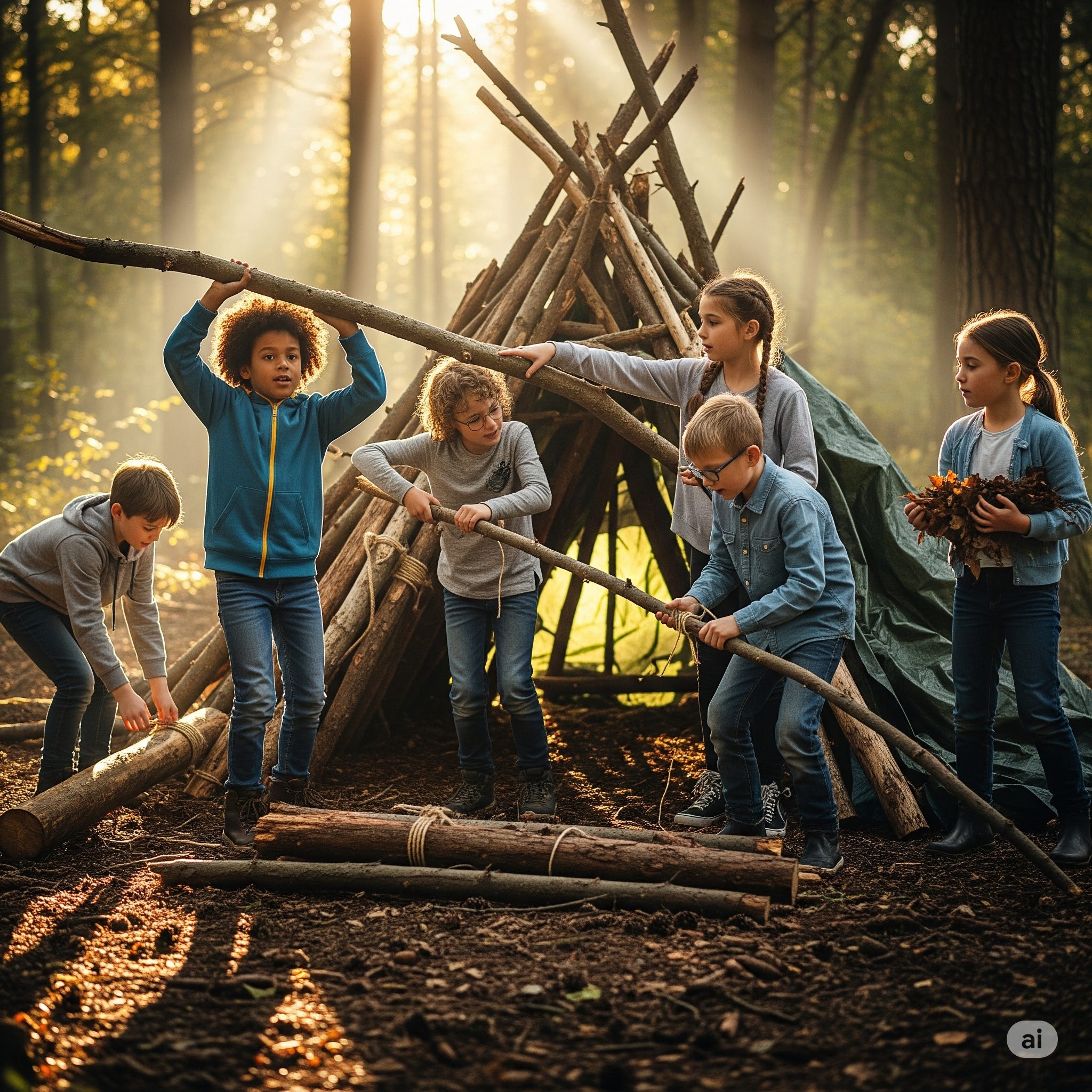
Caption: A diverse group of children aged approximately 6-12 work together to build a large wooden fort structure in a sunlit forest clearing. The children are collaborating to lift and position heavy branches and logs, with golden sunlight filtering through the trees in the background.
Last week, I systematically dismantled the institutions that have turned childhood into a crime. First, I documented how we've criminalized normal independence—arresting parents for letting kids walk home, requiring GPS tracking for ten-year-olds, creating a surveillance state where children learn that freedom is suspicious. Then, I followed the money and discovered something darker: a predatory system that profits $25,000 per case annually from destroying families while spending only $500 to keep them together.
The picture that emerged was brutal. We've built institutions that weaponize child protection against families, that convert poverty into evidence of neglect, that turn schools into recruitment centers for family destruction. Many parents respond to this hostile environment by pulling their children closer, monitoring their every move, scheduling their every moment. The helicopter parents I initially criticized aren't always overprotective by nature—they're exhibiting rational trauma responses to predatory systems designed to hurt them.
But there's another perspective we haven't explored yet, one that gets dismissed and disregarded with alarming consistency: what children actually need, and what they're genuinely capable of when we stop imposing our adultist preconceptions on their development.
This isn't about letting kids "goof off" or run wild. The science reveals something far more profound: when we give children appropriate freedom and agency, we're literally helping their brains develop better than when we keep them locked in gilded cages of constant supervision.
The research is clear, the international examples are compelling, and the children themselves are telling us what they need. The question is whether we're ready to listen.
The Brain Science That Changes Everything
Here's what happens inside a child's brain when they're allowed to play freely, take appropriate risks, and solve their own problems: their neural networks literally wire themselves for competence, resilience, and independent thinking.
The National Institute for Play has compiled research showing that free play is when the cortex builds its most crucial connections. Animals deprived of rough-and-tumble play develop smaller brains, form fewer synaptic connections, and overreact to stress throughout their lives. Play isn't frivolous entertainment—it's the biological process through which children build emotional intelligence, cognitive flexibility, and social competence.
Consider what happens when children engage in seemingly simple activities like repeatedly throwing stones into puddles or playing clapping games. According to research in the Annals of the New York Academy of Sciences, these repetitive play activities form predictive timing circuits in the cerebellum and calibrate motor timing and attention networks. The brain is literally practicing the neural coordination that underlies everything from athletic ability to musical performance to executive function.
The prefrontal cortex—the brain region responsible for decision-making, impulse control, and complex reasoning—particularly benefits from independent play experiences. Studies on juvenile rats showed that social play deprivation during adolescence reduced inhibitory synaptic transmission in both the medial and orbitofrontal prefrontal cortex. Translation: when young mammals don't get to play freely with peers, the brain circuits that regulate behavior and support flexible thinking fail to develop properly.
Earlier neurobiological research found that rough-and-tumble play enhances dopamine-driven plasticity and increases dendritic complexity in the prefrontal cortex. Animals deprived of play show reduced social flexibility and poorer adaptive responses throughout their lives. The prefrontal cortex, striatum, and amygdala—brain regions essential for everything from emotion regulation to strategic thinking—are what researchers call the "primary beneficiaries" of play experience.
Human studies confirm these patterns. A 2014 study of 70 children ages 6-7 found that time spent in less-structured activities—free play, reading, social events—predicted better self-directed executive functioning, while time in highly structured activities predicted poorer executive function. When children have to direct their own activities, they develop the neural pathways for self-regulation and autonomous decision-making. When every moment is scheduled and supervised, those pathways remain underdeveloped.
Perhaps most striking is research showing how parental presence can alter adolescent brain responses during risk-taking tasks. When parents hover too closely, they change the neural patterns in their teenager's developing brain, potentially interfering with the natural process of learning to assess and manage risks independently.
The implications are profound: overprotection may limit opportunities for healthy neurological development. We're potentially constraining how children's brains learn to function independently, which affects how they'll navigate challenges throughout their lives.
What Children Actually Say When We Let Them
The University of British Columbia conducted interviews with children ages 8-15 and their parents about independent mobility. When researchers actually asked children about their experiences and perspectives, remarkable insights emerged.
Jake, an 11-year-old, explained to his mother that he understands "where's safe to be and where's not." His mother described him as "responsible" because "he can make pretty good decisions and...think on his feet." This kind of sophisticated risk assessment isn't unusual—children routinely demonstrate nuanced understanding of safety when adults bother to listen to them.
Sixteen-year-old Tracy described how her parents' communication requirements actually expanded her freedom: "My parents aren't really that strict because they know I'm safe and they know the neighbourhood pretty well.... There isn't really a limit. I always tell my parents where I'm going, and how long I'll be gone for, and when I'll be back." Having to communicate her plans created enough trust that they allowed her a much wider roaming range than kids whose parents demanded constant supervision.
Even children dealing with anxiety showed nuanced self-awareness. Cayden explained that his anxiety makes him less adventurous, describing situations where he avoids certain activities because he gets "panicking because...I have high anxiety." This level of self-reflection and adaptive behavior suggests that children are far more capable of self-regulation than adults typically assume.
Julie, a 12-year-old, questioned why she wasn't allowed to walk to the bus stop, while her parents worried about her ability to handle emergencies. Rather than dismissing her perspective, her parents recognized that they needed to see her "problem-solving skills" develop before granting more independence—acknowledging that children can grow into responsibilities when given appropriate opportunities.
Longitudinal research tracking 350 late adolescents found that maternal helicopter parenting decreased young people's autonomy and relatedness satisfaction, which in turn reduced positive emotions and increased negative ones. Another study of 491 Canadian university students found that perceived helicopter parenting was associated with lower career adaptability and less in-depth exploration of interests and goals.
These aren't theoretical concerns. Young adults themselves report that overcontrol during childhood and adolescence hindered their ability to explore, make decisions, and develop confidence in their own judgment. The very protection we think we're providing often becomes the obstacle to their growth.
The Power Dynamics We Need to Examine
There's a term that rarely appears in mainstream parenting discussions but explains much of what goes wrong in adult-child relationships: adultism. A 2025 analysis in the Journal of Contemporary Behavioural and Social Research defines adultism as the systemic privileging of adult perspectives and the marginalization of children's voices.
Adultism manifests as overcontrol, limiting choices, patronizing language, and emotional neglect. These practices suppress autonomy and create feelings of powerlessness in children. The research is clear: respecting children's decision-making improves self-esteem and reduces depressive symptoms, while consistently undermining their agency does the opposite.
A youth panel convened by the Creative Youth Development National Partnership described adultism as systematic mistreatment that denies young people authority and voice. This isn't just academic theory—it's how children and teenagers experience the constant assumption that adults know better about everything, including their own lives and capabilities.
Researchers studying participatory interviews with children observed that when parents are present, children often look to them for approval or defer to adult opinions rather than expressing their authentic thoughts. This "push and pull" illustrates how adult presence can limit children's genuine expression, highlighting the need to give young people space to speak for themselves.
We've built an entire culture around the assumption that children are incapable, irrational, and in need of constant guidance. But cognitive science research suggests something different. Research has found that young children can excel in certain learning tasks, including aspects of language acquisition and pattern recognition, due to their brain plasticity and exploratory behavior. Their limited prior knowledge sometimes makes them better at learning from sparse data than adults who may be constrained by existing assumptions.
Studies on decision-making show that children's ability to delay gratification and think strategically increases dramatically between ages six and ten, with concepts of fairness and reciprocity developing alongside their capacity for prospective thinking. Children are capable of ethical reasoning and responsible choices much earlier than most adults assume.
The problem isn't children's capabilities—it's our unwillingness to recognize and respect them.
How Other Cultures Get This Right
While American parents agonize over whether their ten-year-old can walk to the corner store, children in other cultures navigate far more complex challenges with remarkable competence.
In the Netherlands, there's a tradition called "droppings" where pre-teen children are taken to a forest and left to navigate home, sometimes at night. Adults may trail them at a distance or give cryptic hints, but the children wear reflective vests, carry phones for emergencies, and successfully find their way back through their own problem-solving and teamwork. Dutch children are widely considered to have some of the highest well-being rates in the world, and their culture of independence contrasts sharply with American helicopter parenting.
While not academic research, the Netflix documentary "Old Enough!" provides a striking illustration of how Japanese culture approaches childhood independence, showing toddlers as young as two successfully completing solo errands while communities provide informal oversight and support. This media example reflects broader cultural attitudes that view such activities as normal developmental milestones rather than dangerous risks.
Germany has approximately 2,000 forest kindergartens (Waldkindergarten) where children ages 3-6 spend entire days in forests or parks engaging in self-directed exploration and hands-on activities. These programs report improved physical health, enhanced social skills, increased creativity and problem-solving abilities, and the development of independence and self-confidence. Children learn to assess risks, navigate natural environments, and collaborate without constant adult intervention.
Norwegian early childhood education emphasizes outdoor free play, with children spending roughly 60% of their time in unstructured exploration. Teachers view learning through discovery as more important than early academics—a stark contrast to America's focus on school readiness and standardized achievement.
These aren't societies that don't care about children's safety. They're cultures that understand the difference between protecting children and infantilizing them, between reasonable precautions and fear-based restrictions.
The Practical Path Forward
Families can shift from overprotection to appropriate autonomy through gradual, intentional changes that build both children's competence and parents' confidence.
Start with baby steps. Young children can choose their clothes or arrange their toys. As they demonstrate competence, parents gradually add responsibilities like setting their own alarm, preparing simple meals, or navigating conflicts with siblings before asking for help. Taking developmental stage into account prevents children from becoming overwhelmed while building genuine confidence.
Establish clear communication patterns. In the UBC study, teenagers emphasized that having to tell parents where they were going and for how long actually gave them more freedom. Tracy explained: "I always tell my parents where I'm going, and how long I'll be gone for, and when I'll be back. They're always just like, 'Have your phone with you, and always answer calls or texts right away.'" Consistent boundaries and open communication create trust without hovering. Children learn to be accountable for their choices while parents learn to assess genuine risks versus imagined ones.
Teach safety skills instead of avoiding all risk. Rather than forbidding independent activities, families can role-play scenarios like interacting with strangers, handling emergencies, and making good decisions under pressure. Familiarity with safety procedures empowers children to handle challenges without constant adult intervention.
Adjust supervision based on competence, not arbitrary age limits. Some eight-year-olds are ready for significant independence; some twelve-year-olds need more guidance. Parents can step back and let children learn from manageable mistakes while remaining available for support when genuinely needed.
Build community support. Individual families can't restore childhood freedom without supportive environments. Connecting with neighbors, other parents, and community organizations creates informal networks that look out for children while reducing individual anxiety about independence.
Community Solutions That Actually Work
Community-level interventions show how infrastructure and social norms can enable rather than restrict childhood independence.
A Belgian pilot study evaluated "Play Streets"—temporary street closures during school holidays that created safe spaces for unstructured play. Researchers fitted 126 children with accelerometers and measured their activity across eight days. During Play Street hours (2:00-7:00 PM), children's moderate-to-vigorous physical activity increased from 27 to 36 minutes, while activity decreased on control streets. Sedentary time dropped from 146 to 138 minutes on Play Streets while increasing on control streets.
The intervention created measurable improvements in children's physical activity and engagement that extended beyond the specific intervention hours. Creating safe play spaces in residential areas effectively increases physical activity while decreasing sedentary time—but it requires communities willing to prioritize children's developmental needs over traffic convenience.
Other neighborhood interventions show similar patterns. Park improvements like adding walking tracks and playgrounds increased visitation and physical activity. Making schoolyards available outside school hours reduced screen time. Traffic calming measures and proximity to amenities increased parents' confidence in allowing independent mobility.
These aren't massive infrastructure projects requiring enormous budgets. They're relatively simple modifications that signal community support for childhood independence while addressing legitimate safety concerns.
The Children Who Are Already Showing Us the Way
Some children are already growing up with the independence and agency that research suggests all children need. Democratic schools like Sudbury Valley give students equal voting power in school governance and complete freedom to direct their own learning. A systematic study of graduates found that about 75% pursued higher education without difficulty, succeeded in varied careers, and were overwhelmingly glad they attended, believing the school prepared them better for adult life than traditional education.
Let Grow's Independence Kits challenge families to assign children incremental responsibilities—walking a dog, running an errand, preparing a meal. Their Play Clubs open school gyms and playgrounds for mixed-age, lightly supervised free play. While comprehensive evaluations are limited, these programs align with research showing that less-structured activities improve executive function and happiness.
The children participating in these programs aren't exceptional. They're ordinary kids whose families and communities have decided to trust their developing capabilities rather than assume incompetence.
What We're Really Protecting Them From
When we examine the actual statistics, much of our protective behavior defends against risks that are statistically negligible while ignoring activities that pose genuine danger.
Children are statistically more likely to be injured as passengers in cars than while walking or cycling independently, according to a 2022 systematic review on children's independent mobility which found higher fatality risks for car passengers than pedestrians or cyclists. Canadian Paediatric Society research shows that the vast majority of injuries in unstructured outdoor play are minor, requiring minimal or no medical treatment, while organized sports actually produce higher rates of serious injury. The odds of stranger abduction—the fear that drives much helicopter parenting—are approximately one in 720,000 according to Let Grow's analysis of crime statistics.
Meanwhile, the psychological risks of overprotection are measurable and significant. Research consistently links helicopter parenting to increased anxiety, depression, reduced self-regulation, and poorer academic achievement. We're protecting children from imaginary dangers while exposing them to real developmental harm.
This doesn't mean ignoring genuine safety concerns or abandoning all supervision. It means calibrating our protective instincts to actual rather than perceived risks, and recognizing that the greatest danger to most children isn't stranger abduction or playground injuries—it's growing up without developing the competence and confidence they need to navigate the world independently.
The Science of Trust
What emerges from this research is a simple but profound insight: children develop best when adults trust their capabilities while providing appropriate support and guidance. This isn't permissive parenting that abandons boundaries or neglectful parenting that abdicates responsibility. It's recognizing that children are human beings with developing but real agency, not problems to be managed or risks to be contained.
The neuroscience shows that independent play and problem-solving literally build better brains. The developmental psychology demonstrates that autonomy support promotes healthy growth while overcontrol undermines it. The international examples prove that cultures trusting children's capabilities produce more resilient, competent young people. The children themselves tell us they want and can handle more responsibility than we typically give them.
The path forward isn't returning to some imagined past where children ran completely unsupervised until dark. It's creating intentional environments where children can develop independence gradually, with community support and age-appropriate challenges that build competence rather than dependence.
We've spent years focusing on everything that could go wrong if we give children more freedom. The research suggests we should be asking a different question: what goes wrong when we don't?
Beyond the Gilded Cage
The surveillance state we've created around children—the GPS tracking, the scheduled playdates, the elimination of unstructured time—isn't protecting them. It's teaching them that independence is dangerous, that adults can't be trusted to recognize their capabilities, and that their own judgment is inherently suspect.
The institutions I've documented over the past week—the predatory child welfare systems, the school-to-CPS pipeline, the medical misdiagnosis machinery—feed on this culture of fear and control. They exploit our terror of what might happen to our children to justify systems that reliably harm families while generating enormous profits.
But there's another way, one that respects both children's developmental needs and parents' legitimate concerns for safety. It requires examining our own adultist assumptions, building communities that support rather than undermine childhood independence, and trusting the science showing that children are far more capable than our culture assumes.
The children hiding phones in their sleeves to cheat on tests, the teenagers struggling with anxiety and depression, the young adults who can't make decisions without parental input—these aren't inevitable outcomes of modern life. They're symptoms of a system that systematically undermines the very capabilities we claim to be protecting.
Children need freedom to develop competence. They need appropriate risks to build resilience. They need agency to develop judgment. They need trust to become trustworthy. The science is clear, the international examples are compelling, and the children themselves are telling us what they need.
The question isn't whether we can afford to give them more independence. The question is whether we can afford not to.
Sources and Context
The following sources were used to compile this article. Each entry includes the source information and the context in which it was used, providing transparency about the research foundation for this analysis.
Neuroscience and Brain Development Research:
National Institute for Play summary: Documented that free play wires the cortex, that animals deprived of play have smaller brains and fewer synaptic connections, and that play builds emotional intelligence and cognitive flexibility. Used to establish the neurological necessity of unstructured play.
Annals of New York Academy of Sciences workshop report: Showed how repetitive play activities like clapping and stone-throwing form predictive timing circuits in the cerebellum and calibrate attention networks. Used to demonstrate how simple play activities build complex neural capabilities.
Frontiers in Neuroscience 2023 study: Found that juvenile rats deprived of social play showed reduced inhibitory transmission in prefrontal cortex during adolescence. Used to prove that play deprivation causes lasting changes in brain circuits responsible for decision-making and behavioral regulation.
PMC behavioral neuroscience research: Showed that rough-and-tumble play enhances dopamine-driven plasticity and dendritic complexity in prefrontal cortex, with play-deprived animals showing reduced social flexibility. Used to establish prefrontal cortex, striatum, and amygdala as "primary beneficiaries" of play experience.
2014 PMC study on structured vs. unstructured activities: Found that time in less-structured activities predicted better self-directed executive functioning while structured activities predicted poorer outcomes. Used to show how autonomy builds neural capacity for self-regulation.
Frontiers in Neuroscience fMRI study: Showed that parental presence can alter adolescent neural responses during risk-taking tasks. Used to demonstrate how overmonitoring may interfere with natural risk-assessment development.
Youth Voices and Perspectives:
University of British Columbia qualitative study: Provided direct quotes from children ages 8-15 about their experiences with independence, including Jake's understanding of safe/unsafe places, Tracy's expanded freedom through communication, and Cayden's self-awareness about anxiety. Used to center children's own perspectives on their capabilities and needs.
PMC dynamic structural equation modeling study: Found that maternal helicopter parenting decreased autonomy satisfaction and increased negative affect in 350 late adolescents. Used to show long-term psychological impacts from youth perspective.
PMC Canadian university student study: Found helicopter parenting associated with lower career adaptability and less exploration among 491 emerging adults. Used to demonstrate how overprotection affects young adults' development.
Children's Cognitive Capabilities:
"The Sweet Spot: When Children's Developing Abilities, Brains, and Knowledge Make Them Better Learners Than Adults": Found that young children can excel in certain learning tasks, including aspects of language acquisition and pattern recognition, due to brain plasticity and exploratory behavior, with limited prior knowledge sometimes making them better learners than adults constrained by existing assumptions. Used to counter assumptions about children's limitations.
Research on prospective thinking and fairness development: Showed that children's ability to delay gratification and strategize increases from age six to ten, with fairness concepts developing alongside prospective thinking. Used to demonstrate children's capacity for ethical reasoning.
Adultism and Power Dynamics:
Journal of Contemporary Behavioural and Social Research letter: Defined adultism as systemic privileging of adult perspectives, manifesting as overcontrol and limiting choices, with respecting children's decisions improving self-esteem and reducing depression. Used to establish theoretical framework for examining adult-child power relationships.
Creative Youth Development panel article: Described adultism as systematic mistreatment denying young people voice and authority. Used to provide youth-led perspective on how adultism is experienced.
PMC research on parental involvement in interviews: Showed how parental presence can limit children's authentic expression during research. Used to illustrate how adult authority affects children's ability to speak honestly about their experiences.
International Models:
Stuyvesant High School article on Dutch "droppings": Described tradition where pre-teens navigate home from forests, often at night, with Dutch children having some of world's highest well-being rates. Used to contrast American fears with successful international approaches to childhood independence.
Netflix documentary "Old Enough!" (Hajimete no Otsukai): Referenced as illustrative media example showing Japanese cultural attitudes toward early childhood independence, where toddlers completing solo errands are viewed as normal developmental milestones. Used to demonstrate how different cultures approach childhood autonomy.
Motherly article on German forest kindergartens: Documented 2,000 Waldkindergarten programs where children ages 3-6 spend days outdoors in self-directed exploration, with benefits including improved physical health, social skills, creativity, and independence. Used to show successful educational models prioritizing autonomy over academics.
PMC Norwegian early childhood research: Found children spend 60% of time in free play with teachers viewing exploration as more important than early academics. Used to contrast Nordic approaches with American school-readiness focus.
Safety and Risk Assessment:
2022 PMC systematic review on children's independent mobility: Found higher fatality risks for children traveling as car passengers than for those walking or cycling independently. Used to provide statistical context for actual transportation risks versus parental fears about independent mobility.
Canadian Paediatric Society position statement on risky play: Documented that the vast majority of risky outdoor play-related injuries are minor, requiring minimal or no medical treatment, while organized sports produce higher rates of serious injury than unstructured play. Used to counter fears about unstructured play dangers and provide statistical context for actual vs. perceived risks.
PMC systematic review of risky play: Found that risky play enhances risk detection and competence, with injuries usually minor. Used to demonstrate that benefits outweigh risks for independent activities.
Let Grow analysis of crime statistics: Provided stranger abduction odds of approximately 1 in 720,000, with only ~105 stereotypical kidnappings occurring annually nationwide. Used to contextualize parental fears against statistical reality.
Practical Implementation:
PMC study on parental autonomy support: Showed negative control reduces autonomous behavior while positive guidance increases it, with fathers' positive guidance particularly effective. Used to support gradual independence strategies and communication-based approaches.
Belgian Play Streets pilot study: Measured 126 children with accelerometers, finding increased moderate-to-vigorous activity (27 to 36 minutes) and decreased sedentary time (146 to 138 minutes) during street closure intervention. Used to provide measurable evidence of community-level solutions.
International Journal of Behavioral Nutrition research: Documented that park improvements, schoolyard access, and traffic calming measures increase physical activity and parental confidence in children's independent mobility. Used to show how infrastructure changes support childhood freedom.
Democratic Education and Youth Agency:
American Journal of Education study of Sudbury Valley School graduates: Found approximately 75% pursued higher education successfully, with graduates believing democratic education prepared them better for adult life than traditional schooling. Used to demonstrate outcomes when children have genuine agency in their education.
Let Grow programs documentation: Described Independence Kits assigning incremental responsibilities and Play Clubs providing mixed-age free play opportunities. Used to show practical applications of autonomy-building approaches.
Each source was selected for its contribution to understanding children's actual capabilities, needs, and perspectives rather than adult assumptions about childhood, providing the evidence base for trusting children's developing competence while supporting their growth through appropriate freedom and responsibility.